When I was first introduced to the art of David Bruehl — work with a solid illustration base and easily recognizable style — I immediately thought, “This guy should tattoo.”
Never one to leave it to the whims of fate, I grabbed the bull by the horns and told him as much. Apparently, I wasn’t the only one to suggest it. David quickly transitioned from a mild mannered illustration student at the well regarded S.C.A.D. in Savannah to a tattoo apprentice in the heartland of Indiana. Quicker than you could say abracadabra, he was on his way to becoming a skilled, versatile tattooer.
David is now in his seventh year of tattooing with an international reputation for his client-centric process, continues to paint and, most importantly, is the husband to his wonderful wife, Kimmy, and father of two amazing boys, Zeke and Abe.
Shawn Porter: Hey David.
David Bruehl: Hey Shawn.
SP: Let’s do the getting to know you. Where were you born?
DB: I was born in Oklahoma City, OK, on November 7, 1979.
SP: I know you have at least one sister — the hot one that I have a crush on. Any other siblings?
DB: That sister, Sheryn, is technically my half-sister, along with my other half-sister, Treisa. I’ve known them as long as I’ve been alive though, so it’s all the same to me. They’re respectively 11 and ten years older than me. (Irish twins!) I also have a younger full sister, Jessica, who’s two years my junior. I essentially grew up among women; I wasn’t really close with my dad.
SP: What were you like as a child? Typical “artsy dreamer” or more conventional kid?
DB: I always looked at myself as a normal kid, but moving back to Oklahoma has resulted in getting my extended family’s impressions of me as a child. Several cousins have described me as, “the kid reading a science book while everyone else was playing army men.” They all seemed to think I was going to be a scientist until I was around 11 or 12 years old, when I started always carrying a sketchbook.
SP: When did you discover you could draw? Did your family encourage it?
DB: I drew a little Halloween bat when I was about three that everyone made a big deal about — how much it looked like what I was drawing. They gushed over the thing so much, I still retain that memory as my proudest moment as a kid. I think on some level, my need to create seeks to relive that moment.
SP: Were there any other artists in the family?
DB: My grandmother painted and worked as a gallery artist, mostly doing wildlife themes. When I was a child, she would bring me with her to her art association meetings, and as a result, I viewed art as being something one could do as a career from the very beginning. She’s retired herself from painting now, unfortunately. Around the time I started attending art school as an adult, my mom introduced an art program into her school district and works as an art teacher now.
SP: When I first started seeing your work, it had a very cohesive “Bruehl” look to it — your pinups in particular were very easily recognizable as having come from you. Has tattooing made it easier or harder for you to adapt to other styles, and how do you keep that from losing your particular aesthetic?
 DB: I think that working outside of one’s comfort zone, imagery wise, is very healthy for an artist. I see it all the time with artists, where someone repeats themselves stylistically and subjectively so much that every fault within their work gets magnified and they lose that freshness. You get the feeling that they’re coasting. Having to synergize with a client’s needs stretches me in ways I wouldn’t have, left to my own devices. My personal aesthetic gets retained by trusting myself and my intuition in creating a piece.
SP: You’ve recently started painting more. With your first gallery show under your belt (DB01-New Works, OKC, OK), you seem to be solidifying a personal iconography: birds, occult/esoteric symbols, numbers and invented crypto-zoology. How much research goes into a new painting? Do you use specific symbols to “charge” the piece? Or do you make your own up to thematically go with the work? Why have you consciously stayed away from “tattoo” iconography in your paintings?
DB: A lot of my painting work is done in an almost subconscious manner. I do a lot of distracted sketching, little tiny drawings, and the ones that resonate with me become paintings. The subject manner comes from being in a place with my children mentally, a simpler land of wonderment and mystery and the like. I’ve actually been looking at the work of Winsor McKay lately, as I think he was sort of coming from the same place creatively.
The symbols within the pieces are “sigils,” which is a blanket term for symbols used to create some sort of effect on reality. A quick and easy example of what I mean is cave painting: man draws buffalo getting killed, and then within a couple days the men in the tribe find a buffalo and kill it for the benefit of the tribe — the art then created the result in the tribe’s eyes. In cultures of the past, artists served a role much more similar to a magician or shaman; we still do, albeit in a more obscure form, especially if you loosen your term of what “art” is. Anyways, getting back to it, the sigils I use are mostly things dealing with personal change, though some are more general, especially the repeated ones. Those specifically serve to connect the work into a unified whole, much like a signature. I don’t use symbols outside of my personal symbol-language, as that’s what I’ve chosen to work within and what resonates the most with me.
Some of my more recent work has incorporated some tattoo iconography, albeit in a more reduced form. There’s several design elements within tattooing that I think work well within paintings as well. In a way, painting started out as an escape from the tattoo juggernaut, which has a way of becoming all-encompassing in one’s life. The fact that some of it has started finding its way into my painting work is a sign of the proper integration of tattooing into my life, I think. In the end, whether it’s a painting or a tattoo, it’s all part of the whole of my work.
SP: You “gained speed” as a tattooist pretty quickly; I remember watching your work progress at a geometric rate and knowing early on that you “got it.” What are your thoughts on traditional apprenticeships? Do you think that the ability to make needles with a soldering iron and jig or being able to build machines is necessary for the modern tattooist?
DB: Tattooing is in a weird spot. Most good artists out there have no interest in taking apprentices, which leaves hopefuls to take on the dangerous task of learning on their own — which really puts a lot of people in a worse position than not knowing anything, since they end up with a bunch to unlearn — or to learn from sketchy bad tattooists who are taking them on for the wrong reasons. It’s inevitable that there’s always going to be new blood becoming part of the community, so there has to be some way to sift through everyone to ensure that the people who deserve it. I don’t know that there’s an answer to that conundrum.
I think knowing every aspect of one’s craft is important. I know how to make needles. I can build a machine from raw materials (metal, magnet wire and some screws). I can make pigment. I can essentially make anything involved in my craft except a power supply. Do I do all of that? No. I no longer make my own needles. I make machines, some of which I keep, some I sell. I don’t make my own pigment, except on rare occasions. Learning all of that, though, connects me to and further refines my process. So much of tattooing is about learning what works for you, rather than knowing the one “right” way to do something. It’s easy to get lost in all that, though. No matter how hard one tries, there’s not going to be that magic machine or magic pigment that’s going to make a person a good tattooist. That’s the result of a lot of hard work and a lot of time spent at the drawing table.

SP: Tattooing is in a weird spot. I can remember headlines when I was a kid boasting, “Tattoos: No longer for Bad Boys and Bikers!” Yet, all of the people covered in the articles were bad-asses or bikers. We’ve finally hit a place where it’s transcended that: almost everyone in our age group has at least one tattoo. But it’s moving past just regular joes and hitting the superculture. What do you think about the “tattooist as celebrity” concept? You know, mix your Ed Hardy energy drink with Sailor Jerry rum and down it when you’re watching Miami Ink — is this good for tattooing?
DB: Not just regular tattoos, it seems like a good chunk of people our age are rocking a half sleeve, or at least one in progress. To me personally, I find celebrity culture in general obnoxious, so seeing it come about within my own craft is especially annoying. As it relates to the tattoo community as a whole, though, I think it’s too complicated to frame it as necessarily good or bad. It’s a total paradigm shift, and it forces us to rethink what our expectations of “tattooing” are.
It’s not really a surprise that it came about, though. The market wants to frame everything simpler and sexier to make it into a commodity, so this “tattoo subculture” comes about, with the clothes, the look, the phones, et cetera. That’s so limited, though, and doesn’t get to the essence of what tattooing is. Most serious tattooists I know don’t relate to that whole thing at all. It almost resembles the “maya” concept of the veil that obscures reality as it is.
The funny thing with it all is that the permanent nature of tattooing itself denies it from being able to be a passing trend. Someone may be into the “tattoo culture” and get a bunch of tattoos then later grow out of it. However, the tattoos are still there. So, as they grow older, they’ve gotta rock them, they inevitably get more, but the nature and style of their tattoos change to reflect their growth.
SP: Cliche interview question, but whose work are you into these days? Tattooers, painters, directors, musicians — whomever. I find that listening to the proper music really helps me write, but can’t read before I work on something, lest Bukowski or Palahniuk get channeled without me realizing it. How does the output of others influence your work?
DB: The first artist that really shifted my perspective in tattooing was Grime. I can trace that to a specific tattoo. When I was very young in tattooing, I was into all that ’99-era new-school cartoony tattooing. Looking at artists online, I found Grime’s portfolio on the Tattoo City Web site. I had heard of him more almost as a legend from people who had been at shops when he did guest-spots. In his portfolio he had a sleeve of Houdini, in a straight jacket, upside down on an arm, rendered almost like a painting of a Catholic saint. It also incorporated some severed flying hands in handcuffs, and a key, with a background that was an abstracted and more dynamic form of Japanese iso bars. It was the first time I saw a tattoo that you couldn’t really pigeonhole into some category. It was simply illustrative. Seeing that really pushed me into a direction; not to do tattoos that looked like Grime’s, but to do tattoos that drew from my approach to subject matter, rather than an established genre within tattooing. (I frequently use the term “genre” rather than “style” to refer to traditional, Japanese, new school, et cetera. I feel it’s a more accurate term.)
 Most of my influences have been more from the painting and illustration world. Jeff Soto and James Jean have both been influences. Kathy Olivas and Brandt Peters are personal friends of mine, and have helped me and definitely influenced my painting work. I owe a lot to them. Musically, a lot of Canadian post-rock stuff like Godspeed You! Black Emperor and HRSTA, along with Beirut, and lot of softer stuff like Belle and Sebastian, and then some ridiculous power metal round me out. Jodorosky is inspiring as a director, as I’m sure you know. I also have gotten a lot from Aronofsky, particularly from The Fountain, which I highly recommend to any visual artist. Winsor McKay, who I mentioned before, is a visual treat …
But going back to tattooists, I’d like to also mention Tim Biedron. It’s been a while since he’s really been a direct influence on my work, but I’ve gotten to work with him a few times at Deluxe this last year, and seeing him go from a rough, energetic stencil to a highly polished tattoo is amazing. He definitely puts out his own vision. My friend Jason Vaughn is right there, too, for much the same reason. Jason also has such a great knack for breaking down subject matter into simplified elegance. Another guy, who I haven’t met or talked to, is Jeff Gogue, who does a purely painterly soft style of tattooing. It seems to me that many guys who do work like that almost use it as an excuse to be a bit sloppy for the sake of energy, but his work in particular is very refined. Then, going in a totally different direction is Spanish and Italian traditionalists, Deno and Gore, and Rudy Fritsch, respectively. They all do a very folky style of tattooing that just has such raw visual power.
That brings me to Dan Higgs. He also seems a bit ubiquitous within modern tattooing, but he, as a whole person, has definitely been an influence. The retired tattooist/musician/magician/poet/painter is such a personality that he has achieved mythical proportions in many ways. I see an undercurrent of an attraction to his weaving of alchemical philosophy into traditional tattooing, but the result for the most part has just been a homogenous genre of “mysterious traditional” without respect to the whole picture. (I’ve been guilty of this.) It seems like the path that Higgs in many ways started should be a jumping off point rather than an end point. I think the permanence of the form of tattooing leads us to use established solutions as a crutch.
I guess my personal vision is to use tattooing to develop synergistic personal narratives. In a way, one person’s experience is every person’s experience, and tattooing records this. In the best form, it’s me utilizing my vision to express my client’s vision culminating in something that ends up becoming more universal. In the more limited form, though, we draw from a standard established symbol system, when more appropriate symbols could be used, instead. There’s definitely growth out there, though. Look at all the nature tattoos people want. How many owls/birds/trees has every tattooist done in the past couple of years? There’s meaning behind all that.
SP: Higgs is a strange case. I’ve seen him flatly turn down a client’s design request and then give them a (well deserved) lecture on why you should know the significance of the Sacred Heart before you get it tattooed on you. What are your thoughts on putting “hidden language” tattoos on clients? You’re one of the few tattooers I know who knows what a lot of these things represent — do you feel a responsibility to talk to a client who wants a symbolically powerful design but who’s ignorant to the meaning?
 DB: I’m a little more light-hearted about it than that. In those situations, I take on the role of the educator. We live in an entire world of symbology, and I think everyone who chooses a tattoo does so because it resonates with them, albeit sometimes on a very subconscious level, so I don’t judge. They likely may not know the specific significance, but a part of them speaks the language. I hope that’s not getting too abstract.
On the same subject, but an even more light-hearted note: Every time a person has ever come in wanting to get a yin yang tattoo, I’ve joked with them that I won’t do it unless they tell me what religion/philosophy it’s associated with. In my seven years of tattooing, I’ve never had someone correctly answer “Taoism” or even “Chinese” philosophy. So they may be ignorant of the origins surrounding the symbol, but they do correctly seek to realize the balance that it represents.
Used like that, tattoos become sigils themselves. Great sigils, as a matter of fact — ones you spent a small portion of your life focusing on just dealing with when receiving the tattoo, and then they’re there forever. I see the same reoccurring themes among clients: simplification, seeking balance, connection to nature, connection to a higher power, connection to art/process/work, self-improvement, and escapism.
Outside of the pure “collector” mentality, tattoos are usually there to symbolize/elicit an effect, so my job is to understand the motivations behind a tattoo and know “the person” behind what they’re wanting. Once I’m there, people tend to be a lot more open to imagery and approach, and I’m able to render something that may be a lot more appropriate to their objectives than what was in their head. I get it all the time, “It’s not at all what I was envisioning, but it’s exactly what I wanted.” I don’t take this as me being some astounding artist, I just listen to what’s behind a person’s words.
SP: You did a set of flash with Dan Rick, but most (or all?) of your work is custom. Do you think a design loses its “power” when it’s constantly reproduced? Or is the opposite true? Have you seen any tattoos done from your designs?
DB: For the most part everything I do is custom. As a community, we’ve kind of moved out of the flash era of tattooing. There’s a lot of flash that’s being put out, but its purpose has changed. Flash exists either for purely artistic reasons, or to act as a jumping off point for clients to figure out what they want tattooed. No one wants something directly off the wall anymore.
As far as a design losing its power? I think much of it depends on the design itself. Some things gain a lot and get refined as different people explore a form and as a result put out some mighty powerful imagery. Other designs are so quaint and personal that repeating them just waters them down. A lot of “clever” tattoos fall into that category, like the finger mustache.
I’ve seen people who have copied my designs before. I’ve seen elements of my work that were obviously my approach in others’ work. (Like roses that are identical to specific ones I’ve done; not drawn like them, but obviously traced from the original.) I’ve also seen a couple fully copied tattoos where it looks like the client must have brought an image of mine from online to their artist. Honestly, those things in no way bother me, but make me feel sad for the other artist and client. Copying my work does nothing to affect me, but serves to define them as unoriginal copiers.
SP: I recently read an interview with tattooer turned “fine artist” Mike Giant. He gives his reasons for quitting tattooing:
“Also, tattooing has become the hardest job I can do and pays the least. I make way more money with REBEL8 and fine art now. And in the end, I’m content just sitting in my studio drawing on paper with Sharpies. I’m tired of drawing other people’s ideas and trying to get those ideas into their skin.”
This is a guy who started tattooing roughly the same time you did. Would you give it up for painting if money wasn’t an issue?
DB: I don’t think money is an issue. If I felt really strongly about it, I would bust my ass as a painter and make that into a successful career. What it comes down to is that I consider tattooing to be my primary medium. It’s what I have the most love for. Sure, there’s lots of frustrating aspects of it, but there’s nothing else like it.
SP: So with the dynamic of tattooing changing, do you ever see yourself taking on an apprentice?
DB: It’s tough. I see the need for it within the community, but I worry a lot about committing myself to teaching someone for that long. I definitely can’t say, “No, I never will.” I suppose if the right person came along with the right art skills and drive … Actually, my friend Jason Vaughn apprenticed in Tampa at Atomic, the shop I worked at several years back. He and I shared the most similar aesthetics and sensibilities in the shop, so I sort of got to act as a mentor back then, but I was pretty green myself. When he first came around, though, just looking at his sketchbooks he had with him, you could just tell that the tattoo community would be missing out if he didn’t become part of it. I think what he’s accomplished so far shows that. He’d be a tough act for another person to follow.
SP: I’ve met Jason — really great guy. That he’s an amazing artist wouldn’t be the first thing I said about him; it would be more about who he is as a person. Same goes for you. So would taking on an apprentice for you be more about what they bring to the table artistically or more what they bring to the trade personality wise?
DB: It’s a combination of both. I’d have to hit it off right with the person, but the art has to be there; I’m of the belief that in order for someone to be great artistically, they need to have a strong personality to provide the drive, endurance and such to create. Natural talent is a myth.

SP: I remember a conversation we had once about you restricting your hours at the shop so you had your tattoo days, your painting days and your family days. Very structured to make sure Kimmy and the boys had dad/husband time. You guys have been together forever — where did y’all meet?
DB: Yeah, I’ve pretty much dropped the painting days from all that, but that’s how it works. Kimmy and I met on IAM — we each had a page and met up through there. Kimmy and I probably did everything you’re not “supposed” to do in relationships: Met on the Internet, moved in together quick, got married quick, had kids quick. It just all works for us. Our relatives say that we seem like two old souls that met up again.
She’s an integral part of the whole dynamic of my work as well. Kimmy helps out where ever she can, helping out with contact with clients, scheduling, Internet work, providing a much needed second opinion on design issues, et cetera. I joke that if she wasn’t involved, it would be weeks before I got back to anyone.
SP: Kimmy is awesome. She seems to really be at ease with my continued attempts to steal Abe (Ed. Note: Abe is David’s youngest son) while still finding time to schedule appointments and keep your clients in the loop.
Going back to Higgs for a second, what’s the connection between guys with big beards and guys who do strange tattoos? You have a big ol’ beard and you’ve tattooed some strange things. Same with Higgs, Hedgie … What does a big beard mean to you?
DB: I’ve had some level of facial hair ever since I could grow it, because without it I look like a child. (I know, I shaved it all off once. Once.) I resisted the mustache part of the beard for a long time until my wife finally convinced me to grow it all out. It really doesn’t have any deeper meaning to me necessarily. I range between letting it get real big and wild, and keeping it trim and well put together depending what mood I’m in. I have to admit, I really like the image of the otherwise well dressed man with just a totally wild beard.
SP: How would you like to be remembered?
DB: I’d like to be known as an honest person who truly pursued his own path while putting the important things first.
SP: Anything I haven’t covered that you’d like to finish up with?
DB: No, I’ve gotten to put a lot of more abstract musings in my head into a concise and concrete form. It might be fair to mention that while I may have a magical perspective on tattoo symbology and its affect on people, I don’t necessarily overtly interact with people on that level. The tattoo consultation process is usually a pretty light, enjoyable experience, rather than deep and intense, which discussion of all this stuff on such a philosophical level might lead people to misunderstand.

David Bruehl tattoos by appointment only at Think Ink Tattoos, 1430 W. Lindsey, Norman, OK 73069. You can contact him about appointment info/consultations via cell at (813) 205-3419 or email him at [email protected].
Please consider buying a membership to BME so we can continue bringing you articles like this one.

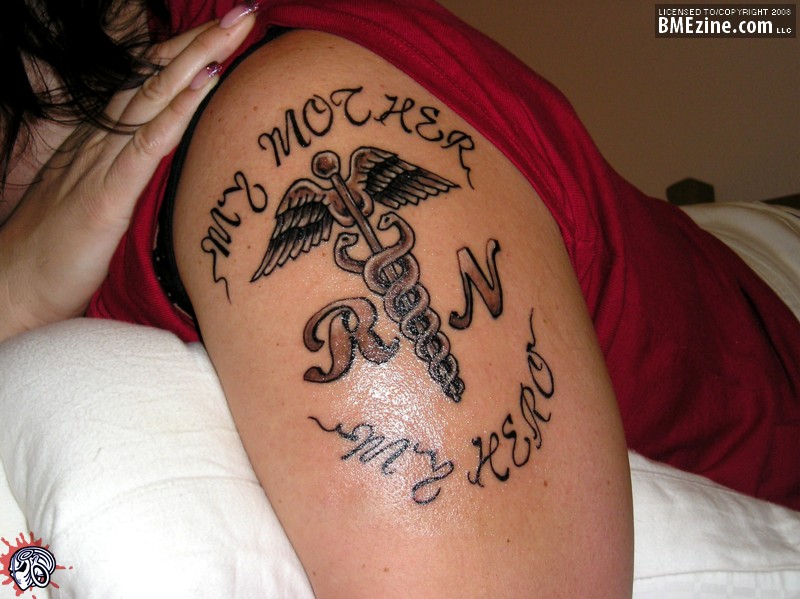 This photo comes from the vaults of BME and included no submission details but I thought it made a nice lead in to the following news story: Nano Ink “Tattoo” Could Monitor Diabetes. It’s a really cool idea and I know diabetes touches the lives of many people, myself included as my father is an insulin dependent diabetic. It’s almost like those old hyper colour shirts (anyone remember those?) only it detects glucose levels and it’s a tattoo!


